Showing posts with label World. Show all posts

Sunday, January 17, 2010

One Love | Playing For Change | Song Around the World


From the award-winning documentary, "Playing For Change: Peace Through Music", comes an unforgettable rendition of the legendary Bob Marley song "One Love

Friday, January 8, 2010

Stand By Me | Playing For Change | Song Around the World


http://playingforchange.com - From the award-winning documentary, "Playing For Change: Peace Through Music", comes the first of many "songs around the world" being released independently. Featured is a cover of the Ben E. King classic by musicians around the world adding their part to the song as it travelled the globe.

Thursday, January 7, 2010

Don't Worry | Playing For Change | Song Around the World


From the award-winning documentary, "Playing For Change: Peace Through Music", comes an incredible rendition of the legendary Bob Marley song "One Love" with Keb' Mo'

Wednesday, December 3, 2008

Obama's grandfather tortured


Hussein Onyango Obama, a British soldier in the second world war, was locked up as a Mau Mau rebel in Kenya

The past usually finds a way of catching up with us. Could Britain's colonial sins pose a risk to our relationship with the soon-to-be most powerful person on Earth?

According to the Times, Barack Obama's grandfather was imprisoned and tortured by the British during Kenya's Mau Mau uprising.

The claim is spread across three pages of the newspaper and illustrated with black and white photographs of detention camps operated by British soldiers in the 1950s.

Hussein Onyango Obama, the president-elect's paternal grandfather, had served with the British army in Burma during the second world war and later found work back in Kenya as a military cook.

Like many army veterans, he returned to Africa hoping to win greater freedoms. But his aspirations soon turned to resentment of the occupying British.

He became involved in the Mau Mau independence movement and was arrested as early as 1949, probably on charges of membership of a banned organisation.

During two years' detention he was subjected to horrific violence, according to the story's authors, Ben Macintyre and Paul Orengoh. Tortures inflicted on Kenyan prisoners sometimes involved such barbaric implements as "castration pliers".

"The African warders were instructed by the white soldiers to whip him every morning and evening till he confessed," Sarah Onyango, 87, tells the Times.

The behaviour of British soldiers is the subject of continuing legal action in the UK courts from victims seeking reparations for torture and mistreatment suffered more than 50 years ago. The Kenyan Human Rights Commission is still gathering evidence.

The alleged torture of Onyango reportedly left him permanently scarred and bitterly anti-British. Barack Obama's memoirs, the paper observes, show that he too is no admirer of British colonialism.

Obama's family connection to the Mau Mau was already known – some US commentators have even used the label to smear him as a "Mau Mau insurgent".

Obama, with more pressing contemporary problems on his plate, is unlikely to be fixated on extracting revenge from the UK. But he may draw the broader historical conclusion that the imposition of torture and repressive violence has a habit of undermining the political legitimacy of world-class powers.

He has already signalled his determination to close the Guantanamo Bay detention centre and speed up withdrawal from Iraq. We will have to wait and see whether his grandfather's experience has a bearing on his policies on Afghanistan and international terrorism.

note* Hussein Onyango Obama was Baracks Grand Father, a tribal leader, and muslim leader, he had Three wives, one had no children, the other gave birth to Obamas father shown above, he passed away some time ago, but while he lived he ruled his local people, and worked as a cook for missionaries which prompted him to convert to his muslim faith. He had a third wife, who barack often referrers to as his grand mother, who still lives in an African hut to this day, complete with an Elect Obama poster on the wall

Sunday, November 16, 2008

Waiting on the World to Change - John Mayer,Lyrics

My home in Washington-William Thomas

Waiting On The World To Change lyrics
Hear the Song

me and all my friends
we're all misunderstood
they say we stand for nothing and
there's no way we ever could
now we see everything that's going wrong
with the world and those who lead it
we just feel like we don't have the means
to rise above and beat it

so we keep waiting
waiting on the world to change
we keep on waiting
waiting on the world to change

it's hard to beat the system
when we're standing at a distance
so we keep waiting
waiting on the world to change
now if we had the power
to bring our neighbors home from war
they would have never missed a Christmas
no more ribbons on their door
and when you trust your television
what you get is what you got
cause when they own the information, oh
they can bend it all they want

that's why we're waiting
waiting on the world to change
we keep on waiting
waiting on the world to change

it's not that we don't care,
we just know that the fight ain't fair
so we keep on waiting
waiting on the world to change

and we're still waiting
waiting on the world to change
we keep on waiting waiting on the world to change
one day our generation
is gonna rule the population
so we keep on waiting
waiting on the world to change

we keep on waiting
waiting on the world to change

Saturday, November 8, 2008

Yes We Did- Barack Obama Wins ,World Rejoices-see the video


The world rejoices as Barack Obama wins a transformational election which will reshape US politics and the US role on the world stage.Yes We Can!
Yes We Did!
if you can't see the video click here to view it!


AFROMAN LYRICS

"Hush"

[Hook (Afroman talking)]
Hush, hush (yeah yeah)
Somebody's callin my name (if you listen closely baby)
Hush, hush (yeah yeah)
Somebody's callin my name
Hush (listen baby) hush (somebody's callin)
Somebody's callin my name
Oh my lord, oh my lord, what shall I do

(A man sometimes girls think I'm crazy cause I wake
her up and I tell her)
Sounds like Jesus (sounds like Jesus)
Somebody's callin my name (I know I'm high but baby)
Sounds like Jesus
And somebody's callin my name
Sounds like Jesus
Somebody's callin my name
Oh my lord, Oh my lord, what shall I do

(You know man, I think about all the hard times that I
went through and I think)
I'm so glad that trouble don't last always
I'm so glad I'm glad that trouble don't last always
Oh my lord, Oh my lord, what shall I do

I gotta feelin, that everything's gonna be all right
I gotta feelin everything's gonna be all right
I gotta feelin that everything's gonna be all right
Be all right
Be all right
Be all right

(A man it's funny cause I learnt this song when I was a little kid
When I went to visit my granddaddy down there in Mobile, Alabama
He stayed in this place called Trendy Garden you know what I'm sayin?
He used to grow his vegetables right there on the side of the house
And every now and then he'd get me to help him out know what I'm sayin?
And as he was like weedin out his garden and everything
He'd sing all kinda tunes and hymns know what I'm sayin?
And sometime he'd sing the same one like over and over and over again
You know what I'm sayin?
He'd get tired of singin the words
Sometimes he'd take a sip of his water outta that glass jar, set it back down
And while we was plantin them collard greens, he'd hum it
Just like this right here, help me out cuz, you know how we used to do it)

[*humming*]

It gets all in my hands
It gets all in my feet
It makes me wanna sing my song
To every little girl I meet
It gets all in my heart
It gets all in my sole
It comes straight out my mouth
And then I lose control
Cause I, I got this feelin, that everything's gonna be all right
Be all right
Be all right
Be all right

Sunday, February 24, 2008

Kailasa Temple, India-the largest cantilevered rock ceiling in the world-Photos

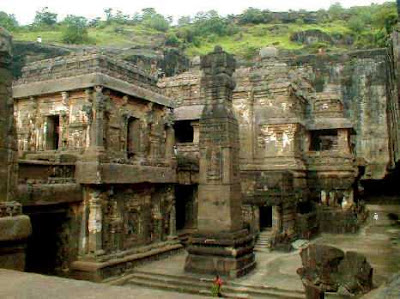
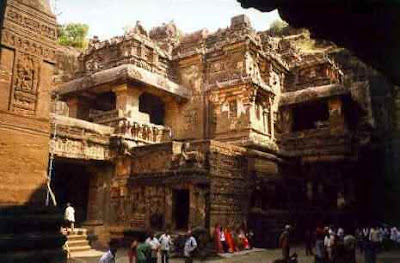
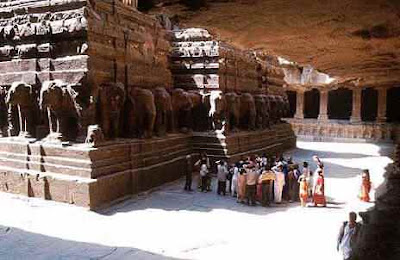
Unlike other caves at Ajanta and Ellora, Kailasa temple has a huge courtyard that is open to the sky, surrounded by a wall of galleries several stories high.
Kailasa Temple, cave #16 at Ellora, India© Courtney Milne
Kailasa Temple, cave #16 at Ellora, India
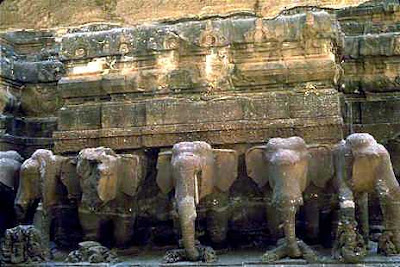
Dramatic sculptures fill the courtyard and the main temple, which is in the center.
It must have been quite a spectacular sight when it was covered with white plaster and elaborately painted.


The gigantic, 8th century Kailasa Temple at Ellora, Cave 16,
was chiselled from solid stone


Described as Cave 16, the Kailasa Temple is considered
the pinnacle of Indian rock-cut architecture


Although all of the caves at Ellora are stunning architectural feats, the Hindu Kailasa Temple is the jewel in the crown. Carved to represent Mt. Kailasa,
the home of the god Shiva in the Himalayas, it is the largest monolithic structure in the world, carved top-down from a single rock. It contains the largest cantilevered rock ceiling in the world.
Within the courtyard is the massive multi-level temple, its pyramidal form replicating the real Mount Kailasa, the Himalayan peak said to be the home of the Hindu god Siva.

The scale at which the work was undertaken is enormous. It covers twice the area of the Parthenon in Athens and is 1.5 times high, and it entailed removing 200,000 tonnes of rock. It is believed to have taken 7,000 laborers 150 years to complete the project.

The rear wall of its excavated courtyard 276 feet (84 m) 154 feet (47 m) is 100 ft (33 m) high. The temple proper is 164 feet (50 m) deep, 109 feet (33 m) wide, and 98 feet (30 m) high.

It consists of a gateway, antechamber, assembly hall, sanctuary and tower. Virtually every surface is lavishly embellished with symbols and figures from the puranas (sacred Sanskrit poems). The temple is connected to the gallery wall by a bridge.
Learn More
world-mysteries.com

Kailasa Temple, India-the largest cantilevered rock ceiling in the world-Photos

Unlike other caves at Ajanta and Ellora, Kailasa temple has a huge courtyard that is open to the sky, surrounded by a wall of galleries several stories high.

Kailasa Temple, cave #16 at Ellora, India© Courtney Milne

Kailasa Temple, cave #16 at Ellora, India
Dramatic sculptures fill the courtyard and the main temple, which is in the center.
It must have been quite a spectacular sight when it was covered with white plaster and elaborately painted.


The gigantic, 8th century Kailasa Temple at Ellora, Cave 16,
was chiselled from solid stone


Described as Cave 16, the Kailasa Temple is considered
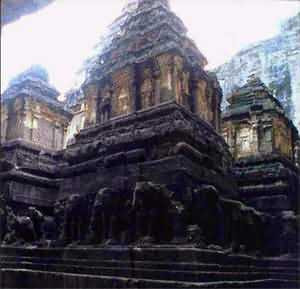
the pinnacle of Indian rock-cut architecture


Although all of the caves at Ellora are stunning architectural feats, the Hindu Kailasa Temple is the jewel in the crown. Carved to represent Mt. Kailasa,
the home of the god Shiva in the Himalayas, it is the largest monolithic structure in the world, carved top-down from a single rock. It contains the largest cantilevered rock ceiling in the world.
Within the courtyard is the massive multi-level temple, its pyramidal form replicating the real Mount Kailasa, the Himalayan peak said to be the home of the Hindu god Siva.

The scale at which the work was undertaken is enormous. It covers twice the area of the Parthenon in Athens and is 1.5 times high, and it entailed removing 200,000 tonnes of rock. It is believed to have taken 7,000 laborers 150 years to complete the project.

The rear wall of its excavated courtyard 276 feet (84 m) 154 feet (47 m) is 100 ft (33 m) high. The temple proper is 164 feet (50 m) deep, 109 feet (33 m) wide, and 98 feet (30 m) high.

It consists of a gateway, antechamber, assembly hall, sanctuary and tower. Virtually every surface is lavishly embellished with symbols and figures from the puranas (sacred Sanskrit poems). The temple is connected to the gallery wall by a bridge.
Learn More
world-mysteries.com

Wednesday, January 23, 2008

The Biggest Pearls in the World


Our attraction to pearls is timeless. Among the first gems known to early humans, pearls have grown in value and appeal from accidental finds by fishermen to a multibillion-dollar industry. Their rarity has made them a traditional sign of wealth, filling vaults from Ancient Egypt to Hollywood and gracing many of history’s famous figures.


What is a pearl? A pearl is mostly aragonite crystals, a form of calcium carbonate (CaCO3) which also makes up other marine organisms from coral to sea urchins. Pearls are produced by a variety of mollusks in warm fresh and sea waters around the world. They appear in a wide range of colors, shapes, and sizes


.
How do pearls form? The mollusk protects its delicate interior by coating foreign objects (usually a tiny piece of shell or parasite) with calcium carbonate, the same substance that lines the inside of their shells. This “seed” grows larger as the mollusk continues to coat it. Among the mollusks that can produce pearls are mussels, oysters, clams, snails, conch, and abalone.


Pearls vary in size from a pin head to pigeon's egg size. The largest ever found, called the Hope Pearl, is 2 inches (5 cm) long, 3.25-4.5 inches (6.5-11.25 cm) in circumference, and weighs 454 carats (about 90 grams). It was named for Henry Philip Hope, one of the owners, who insisted the name be kept as a condition of the sale of the gem (just as he did with the Hope Diamond). It may be seen in the South Kensington Museum in London, the British Museum of Natural History.


Myth
Many people think of wild oysters ingesting a grain of sand as the foreign body which stimulates nacre production.
Living in the sea, oysters are constantly ingesting and expelling sand and irritants.
Only when something becomes lodged - like a piece of shell, bone, coral or parasite does the oyster start nacre production.